12345.png)


🛒 Imagine You're Building the Next Amazon...
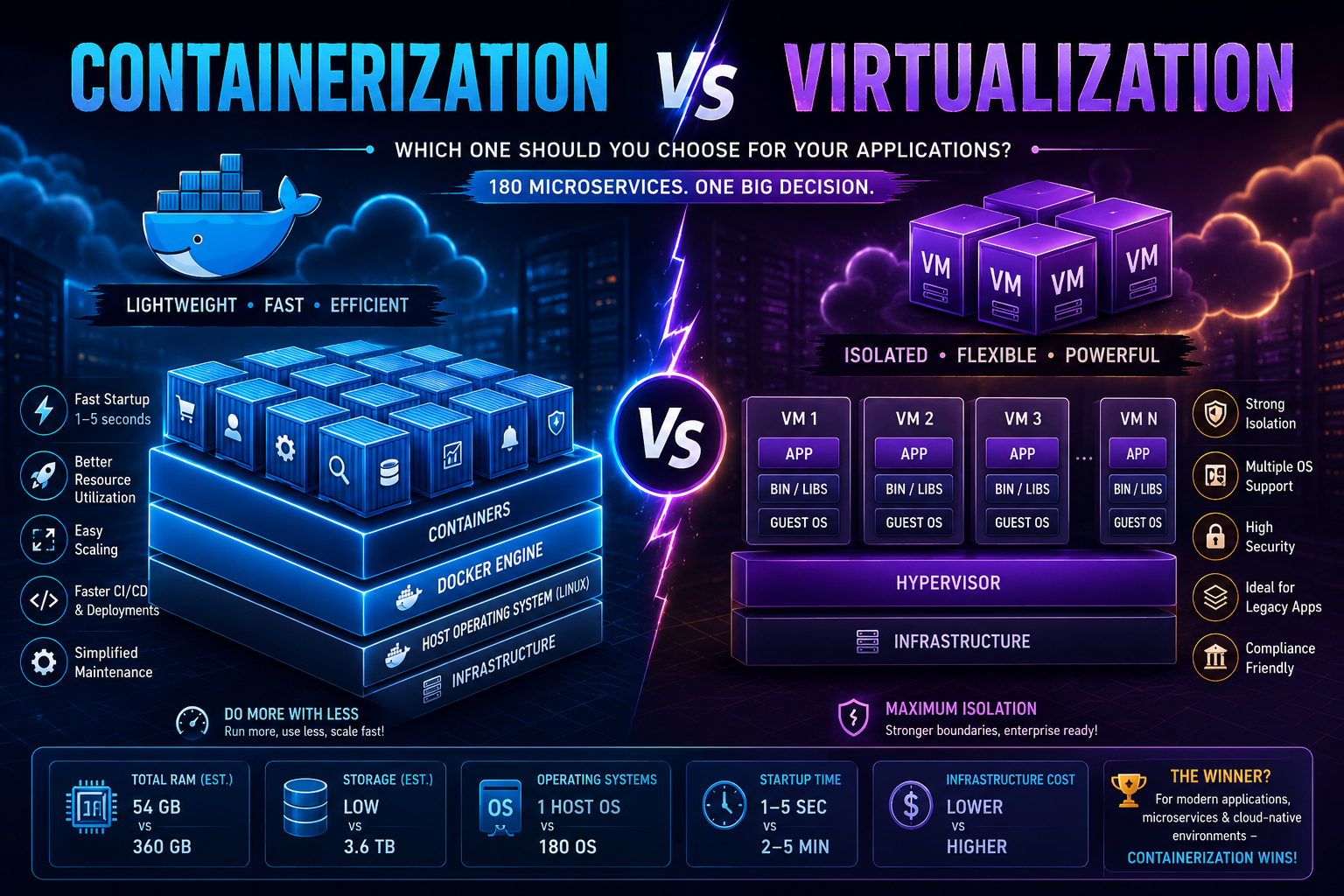
Your company is developing a large-scale e-commerce platform similar to Amazon or Flipkart.
The application isn't a single program—it's built using 180 independent microservices, each responsible for a specific business function.
Some of them include:
👤 User Service
📦 Product Catalog
🔍 Search
🛍️ Cart
💳 Payment
📋 Order Management
🚚 Shipping
⭐ Reviews
🔔 Notifications
🤖 Recommendation Engine
📊 Analytics
🔐 Authentication
🛠️ Admin Portal
...and 165+ additional services
Each service is developed, tested, deployed, and scaled independently.
Now comes one of the biggest infrastructure decisions...
Should we deploy these services using Virtual Machines (VMs) or Containers?
Let's understand this with a real-world scenario.
🖥️ Option 1: Virtualization (VM-Based Deployment)
In a traditional virtualized environment, every microservice runs inside its own Virtual Machine.
Architecture
                       🏢 Physical Server
                           │
                    ───────────────
                     Hypervisor
                    ───────────────
        ┌────────────┬────────────┬────────────┐
        │            │            │            │
    ┌────────┐   ┌────────┐   ┌────────┐   ┌────────┐
    │ VM-1   │   │ VM-2   │   │ VM-3   │   │ VM-4   │
    ├────────┤   ├────────┤   ├────────┤   ├────────┤
    │Ubuntu  │   │Ubuntu  │   │Ubuntu  │   │Ubuntu  │
    │Java    │   │Java    │   │.NET    │   │Python  │
    │Product │   │Cart    │   │Payment │   │Search  │
    └────────┘   └────────┘   └────────┘   └────────┘

                     ..............

                 180 Independent VMs
What's Inside Every VM?
┌──────────────────────────┐
│ Operating System         │
├──────────────────────────┤
│ Runtime (Java/.NET)      │
├──────────────────────────┤
│ Libraries                │
├──────────────────────────┤
│ Application              │
└──────────────────────────┘
Essentially, 180 services = 180 operating systems.
📊 Estimated Infrastructure Requirements
| Component | Approximate Value |
|---|---|
| Microservices | 180 |
| Virtual Machines | 180 |
| Average RAM per VM | 2 GB |
| Total RAM Required | 360 GB |
| Average Storage per VM | 20 GB |
| Total Storage | 3.6 TB |
📦 Option 2: Containerization
Instead of creating 180 Operating Systems...
We install one Host Operating System and run all services as lightweight containers.
Architecture
                  🏢 Physical Server
                          │
                 ───────────────────
                  Linux Host OS
                 ───────────────────
                          │
                 Docker Engine
──────────────────────────────────────────────

┌──────────┐
│ Product  │
└──────────┘

┌──────────┐
│ Cart     │
└──────────┘

┌──────────┐
│ Payment  │
└──────────┘

┌──────────┐
│ Search   │
└──────────┘

┌──────────┐
│ Shipping │
└──────────┘

................

📦 180 Containers
What's Inside a Container?
┌─────────────────────┐
│ Application         │
├─────────────────────┤
│ Runtime             │
├─────────────────────┤
│ Dependencies        │
└─────────────────────┘

Shared Linux Kernel
❌ No Operating System.

That's why containers are so lightweight.
The operating system is shared.
📊 Estimated Infrastructure Requirements
| Component | Approximate Value |
|---|---|
| Microservices | 180 |
| Containers | 180 |
| Average RAM | 300 MB |
| Total RAM Required | 54 GB |
| Storage | Much Lower |
| Operating Systems | 1 Host OS |
🎯 Real-World Example
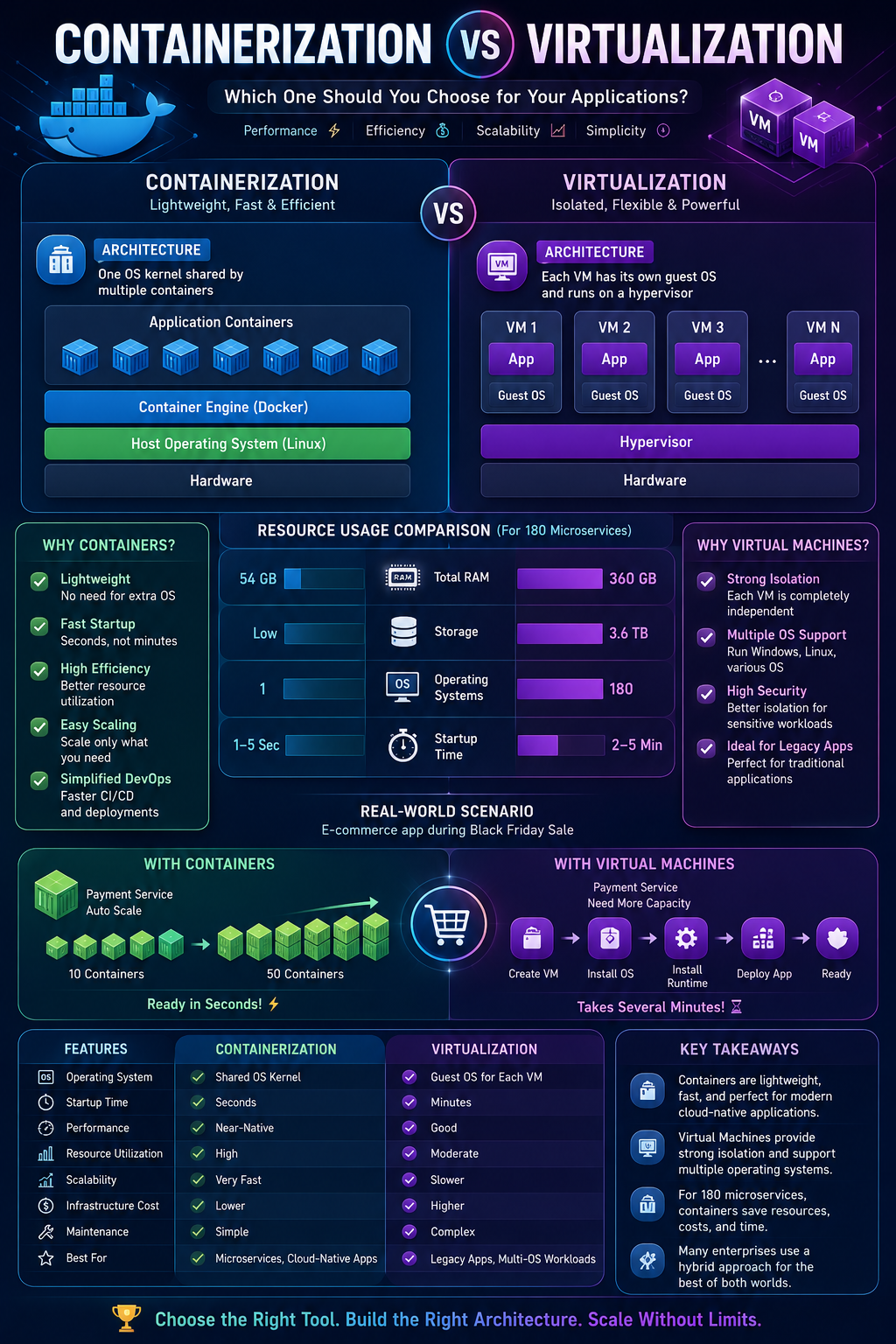
Imagine your e-commerce platform receives 10x more traffic during a festive sale.
With Virtual Machines
You need to:
Create a new VM
Install the OS
Install required runtime
Configure networking
Deploy the application
Start the VM
⏱️ Time Required: Several minutes
With Containers
Simply increase the number of running containers.
Payment Service

10 Containers
        ↓
50 Containers
⏱️ Time Required: A few seconds
🔧 Simplified Maintenance
Instead of maintaining
180 Operating Systems
you maintain
1 Host Operating System.
🚀 Faster CI/CD
New versions can be deployed in seconds.
Perfect for Agile and DevOps teams.
💰 Infrastructure Comparison
| Metric | Virtualization | Containerization |
|---|---|---|
| RAM | 360 GB | 54 GB |
| Storage | 3.6 TB | Much Lower |
| Operating Systems | 180 | 1 |
Note: These are simplified estimates for educational purposes. Actual resource requirements depend on workload, application architecture, and scaling strategy.
⚖️ Side-by-Side Comparison
| Feature | 🖥️ Virtualization | 📦 Containerization |
|---|---|---|
| Operating System | One OS per VM | Shared Host OS |
| Startup Time | Minutes | Seconds |
| Memory Usage | High | Low |
| Storage | High | Low |
| Performance | Good | Near Native |
| Resource Utilization | Moderate | High |
| Deployment Speed | Slow | Very Fast |
| Scaling | Slower | Extremely Fast |
| Infrastructure Cost | High | Lower |
| Maintenance | Complex | Simple |
| Best For | Legacy Applications | Microservices & Cloud-Native Apps |
🏆 Key Takeaways
Virtual Machines offer strong isolation but consume more resources and require higher maintenance.
Containers are lightweight, portable, and designed for modern microservices.
For applications with 180 microservices, containerization significantly reduces infrastructure costs while improving scalability and deployment speed.
The best enterprise architectures often combine Virtual Machines for infrastructure isolation with Containers for application deployment.
In today's cloud-native world, containers have become the preferred choice for building scalable, resilient, and cost-effective microservices applications.